

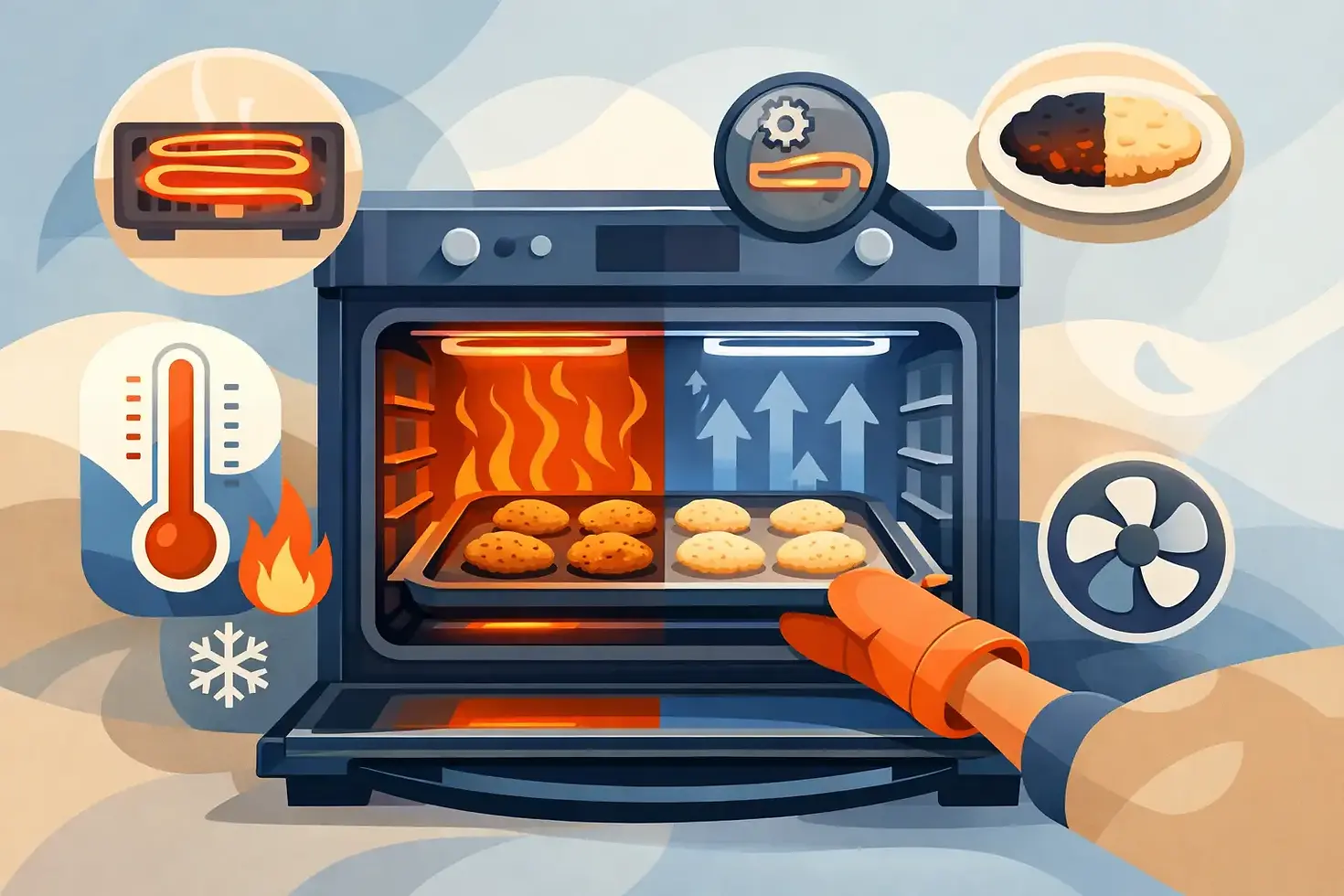
Why Your Oven Is Not Heating Evenly

You notice it first in dinner, not in the appliance. One pan of roasted vegetables comes out with charred corners and pale pieces in the middle. Cookies on the top rack brown too fast while the bottom tray still looks underdone. If your oven is not heating evenly, the problem is usually more than bad luck with a recipe.
Uneven oven heat is one of the most common cooking complaints homeowners deal with, especially when the appliance still seems to turn on and reach temperature. The frustrating part is that the issue can come from a few different places. Sometimes it is a simple airflow or rack-position problem. Other times, it points to a failing heating element, a bad temperature sensor, or a control issue that needs professional repair.
Why an oven not heating evenly matters
When an oven cooks unevenly, it does more than ruin a batch of cookies. It throws off weeknight meals, wastes groceries, and makes it hard to trust the appliance. For busy households, that means extra time, extra cost, and one more thing to manage at the end of a long day.
It can also be a sign that a part is beginning to fail rather than a one-time fluke. An oven that overheats in one area and underheats in another may still appear functional, but it is no longer doing its job consistently. Catching that early can help you avoid larger repairs or the temptation to replace an appliance that may still have years of life left.
Common reasons your oven is not heating evenly
The cause depends on the type of oven, the age of the unit, and whether the problem happens all the time or only on certain settings.
A weak bake or broil element
In electric ovens, the bake element at the bottom does most of the work during standard baking. If that element is weak, damaged, or not cycling correctly, the oven may still heat up but not maintain even temperatures. Food may cook faster on top if the broil element is overcompensating, or the bottom of dishes may stay underdone.
Sometimes the damage is visible. You might see blistering, cracks, or a spot where the element has burned out. In other cases, the element looks fine but still does not heat properly.
A faulty temperature sensor
The temperature sensor tells the control board how hot the oven is. If it starts giving inaccurate readings, the oven may shut heat off too soon or keep heating longer than it should. That can create hot spots, uneven baking, and temperature swings from one cycle to the next.
This is one of those problems that often feels random to a homeowner. One meal turns out fine, the next one is off by enough to notice.
Trouble with the convection fan
If you have a convection oven, the fan is supposed to circulate hot air for more even results. When that fan slows down, runs inconsistently, or stops working, the oven can lose one of its biggest advantages. Food may brown unevenly or cook differently from front to back.
Convection issues can be especially noticeable when baking multiple trays at once. If one pan consistently finishes well before another, even after rotating them, the fan may not be moving heat the way it should.
Bad door seal or heat loss
A worn or damaged oven door gasket can let heat escape. That may not sound dramatic, but even small heat loss can affect performance, especially during longer baking cycles. The oven has to work harder to maintain temperature, and some areas may end up hotter or cooler than others.
If the door does not close tightly or the seal looks cracked, flattened, or loose, that is worth attention.
Control board or thermostat calibration problems
Modern ovens rely on electronic controls to regulate temperature. If the control board is not cycling the heating system correctly, the oven may drift above or below the set temperature. Some ovens can also fall out of calibration over time.
Calibration is one of the more nuanced issues because the oven may be consistently off rather than completely broken. If your oven always seems to run 25 degrees low, for example, the problem may be different from an oven that swings wildly throughout the cooking cycle.
A few things homeowners can check first
Not every uneven-heating complaint means a part has failed. A few practical checks can help separate a use issue from a repair issue.
Check rack placement and pan size
Large baking sheets, oversized casserole dishes, or foil placed too aggressively can block airflow inside the oven. That is especially true in convection models. If heat cannot circulate well, food will not cook evenly.
Rack position matters too. A dish too close to the bottom element may overbrown underneath, while food placed too high may brown on top before the center finishes.
Preheat longer than you think you need to
Many ovens beep before the entire cavity has fully stabilized. For baking, that extra 10 to 15 minutes of preheating can make a real difference. This is particularly true with heavier dishes like casseroles, breads, and anything baked in cast iron.
Rotate food when it makes sense
Some recipes benefit from rotating the pan halfway through cooking. That is not always a fix for a broken oven, but it can help if your unit has a mild hot spot. If rotation barely helps, or if the difference is dramatic every time, the issue is likely mechanical rather than user-related.
Look for obvious element damage
In an electric oven, inspect the bake and broil elements when the oven is off and cool. If one looks cracked, blistered, or separated, stop using the oven and have it checked. A damaged element is not something to ignore.
Signs it is time for repair, not more troubleshooting
There is a point where repeated testing stops being helpful. If your oven is not heating evenly across multiple recipes and settings, repair is usually the smarter next step.
A service call makes sense when food is consistently raw in the center and overdone on the edges, one rack cooks much faster than another despite rotation, the oven takes far too long to preheat, the temperature seems noticeably inaccurate, or you see visible damage to an element or seal. It is also worth calling for help if you smell something unusual during heating or notice error codes on the display.
These issues often come down to components that need testing with the right tools. From the outside, a failing sensor and a weak heating element can look like the same problem. Accurate diagnosis matters, because replacing the wrong part costs time and money and still leaves you with an oven you cannot rely on.
Why uneven heating is not always a replacement issue
A lot of homeowners assume an inconsistent oven is simply getting old and should be replaced. Sometimes that is true, especially if the appliance has multiple major problems or parts are no longer available. But in many cases, uneven heating comes from a repairable issue.
That could be a sensor, element, fan motor, door gasket, or control-related problem. Compared with the cost and hassle of replacing a range or wall oven, repair is often the more practical choice. It also lets you keep an appliance that otherwise fits your kitchen and still has useful life left.
For homeowners in the Kansas City area, that matters. Replacing a major appliance is rarely convenient, and it is almost never cheap. When a repair can restore consistent performance, it is often the better path.
What to expect from a professional diagnosis
A proper diagnosis usually starts with listening to how the problem shows up in real use. Does the oven run hot all the time, or just on bake? Is the issue worse on one side? Does convection make any difference? Those details help narrow down the cause.
From there, a technician can test temperature accuracy, inspect the heating system, evaluate the sensor, and check whether the control is cycling normally. On some models, the problem is straightforward. On others, it takes a little more work because several components can affect heat balance.
That is one reason homeowners often appreciate having a local company handle it. You want someone who has seen the common failures, works on major brands, and can tell the difference between a quick fix and a bigger issue. At Arrowhead Appliance Repair, that practical, no-pressure approach is exactly what many families are looking for when dinner keeps coming out wrong.
If your oven has become unpredictable, trust what you are seeing. A good oven should not make every meal feel like a guess, and getting it checked now can save a lot of frustration later.


Comments